

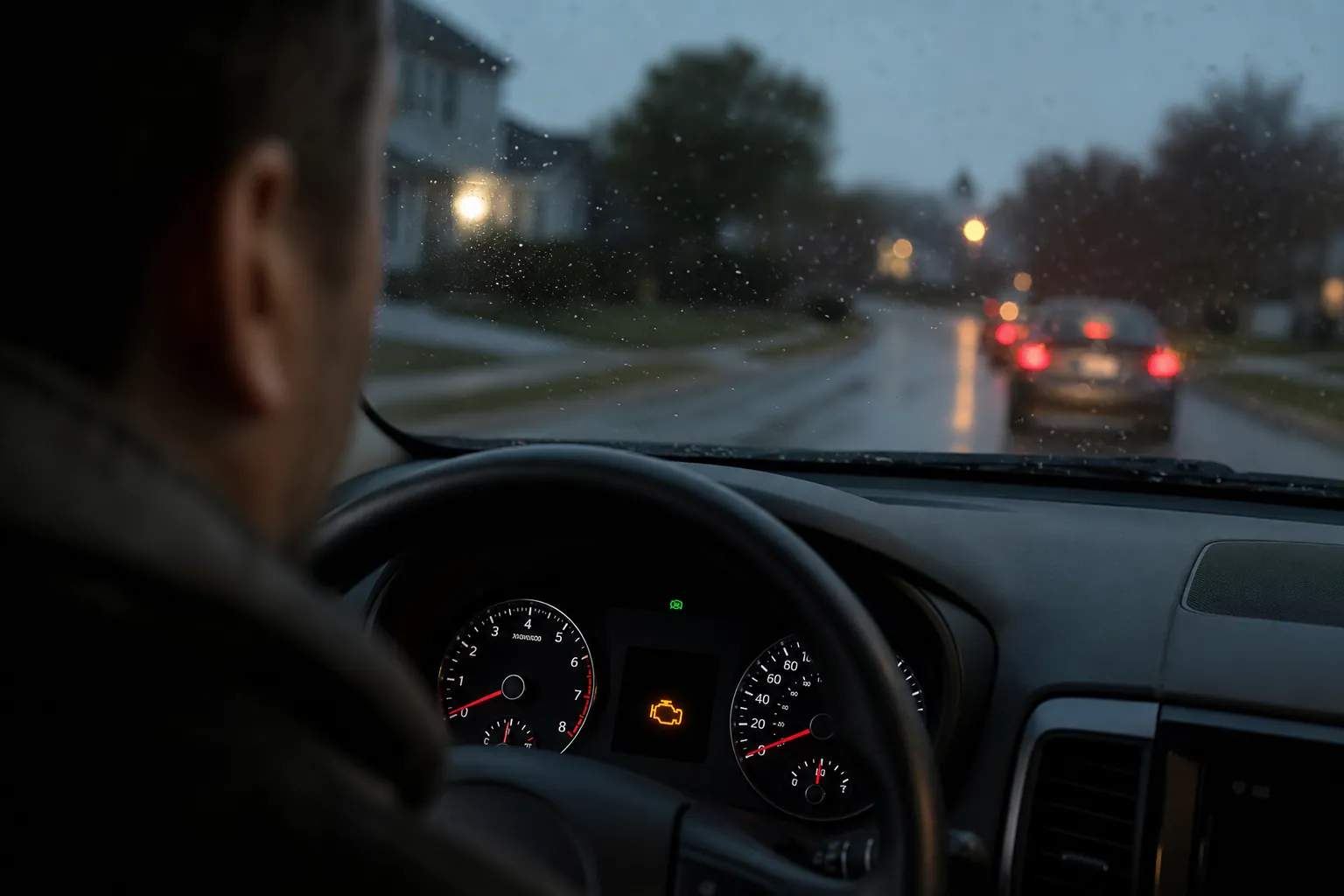
The check-engine light is the most misunderstood light on the dash. It doesn't mean pull over right now, and it doesn't mean ignore it for six months either. It means the engine computer logged a fault code and saved the details for whoever reads it next, and what that code says is the difference between a $25 fix and a $2,500 one.
Here are the seven causes that trigger the light most often, with realistic 2026 prices at an independent US shop, plus the one distinction that actually matters for urgency: whether the light is steady or flashing. Figures assume a typical sedan or crossover; luxury badges and buried engine layouts run higher.
A steady light means the computer found a problem that isn't causing immediate damage, usually something in the emissions or sensor systems. Your car is safe to drive normally, but get it diagnosed within a week or two, because some minor-looking codes quietly drag down fuel economy or wear out other components.
A flashing light is different. It means the engine is actively misfiring and unburned fuel is pouring into the exhaust, where it can overheat and destroy the catalytic converter — a $1,500-plus part — in a matter of minutes. Ease off the throttle, get off the highway, and stop driving; a $100 tow is far cheaper than a new converter.
A loose or worn gas cap is still the single most common trigger, because it breaks the seal on the fuel system and sets an evaporative-emissions code. Tighten the cap until it clicks, and the light usually clears itself after a few days of driving. If the cap's rubber seal is cracked, a replacement runs $20–$70.
If the cap isn't the culprit, the leak is somewhere else in the EVAP system: a cracked hose, a stuck purge valve, or a failing charcoal canister. A purge valve is a $150–$350 job in 2026, while a canister can push $400–$700. Pinpointing the leak usually takes a smoke test, typically $90–$150.
Oxygen sensors measure how completely the engine burns fuel, and they simply wear out, often between 80,000 and 120,000 miles. Expect $275–$550 installed, depending on which of the two to four sensors failed and how accessible it is. Ignoring a dead one costs you 10–15% in fuel economy and slowly poisons the catalytic converter.
The mass airflow (MAF) sensor tells the computer how much air is entering the engine. A dirty or failing one causes rough idle, hesitation, and poor mileage. Sometimes a $100–$150 cleaning fixes it; a new sensor installed typically runs $300–$450.
Misfire codes (P0300 through P0308) mean one or more cylinders aren't firing, and worn spark plugs or a failed ignition coil are the usual suspects. A full set of plugs runs $180–$400 in 2026, more on V6 engines where the intake manifold has to come off first. Ignition coils run roughly $200–$400 per coil, parts and labor.
This is the category that makes the light flash. A steady light with a stored misfire code is a book-an-appointment problem; a flashing light is a stop-driving-now problem, for the catalytic-converter reasons above.
The catalytic converter (code P0420 or P0430) is the one nobody wants to hear. Replacement runs $1,400–$2,800 at most shops in 2026, and past $3,000 on some trucks and hybrids, because the honeycomb inside is packed with platinum, palladium, and rhodium. The good news: converters rarely die on their own. They're usually killed by ignored misfires or bad O2 sensors, which is exactly why the cheaper repairs above are worth doing promptly.
The humbler surprise on this list is the thermostat. When it sticks open, the engine never reaches full operating temperature and sets code P0128 — a $250–$500 fix that also restores your heater output and your gas mileage.
Keep the sequence simple and cheap-first.
One caveat about free code reads: a code names a symptom, not always a cause. An O2 sensor code, for example, is frequently triggered by a vacuum leak or an exhaust leak rather than the sensor itself. That diagnostic legwork is the part worth leaving to a licensed shop like Acme Auto Repair, because an accurate diagnosis before anyone buys parts is what keeps a $300 problem from becoming a $900 one.
Treat the light as your car's cheapest early-warning system. A steady glow is a two-week deadline, a flashing one is an emergency, and handling both on schedule keeps most of the items on this list at the affordable end of your repair budget.