


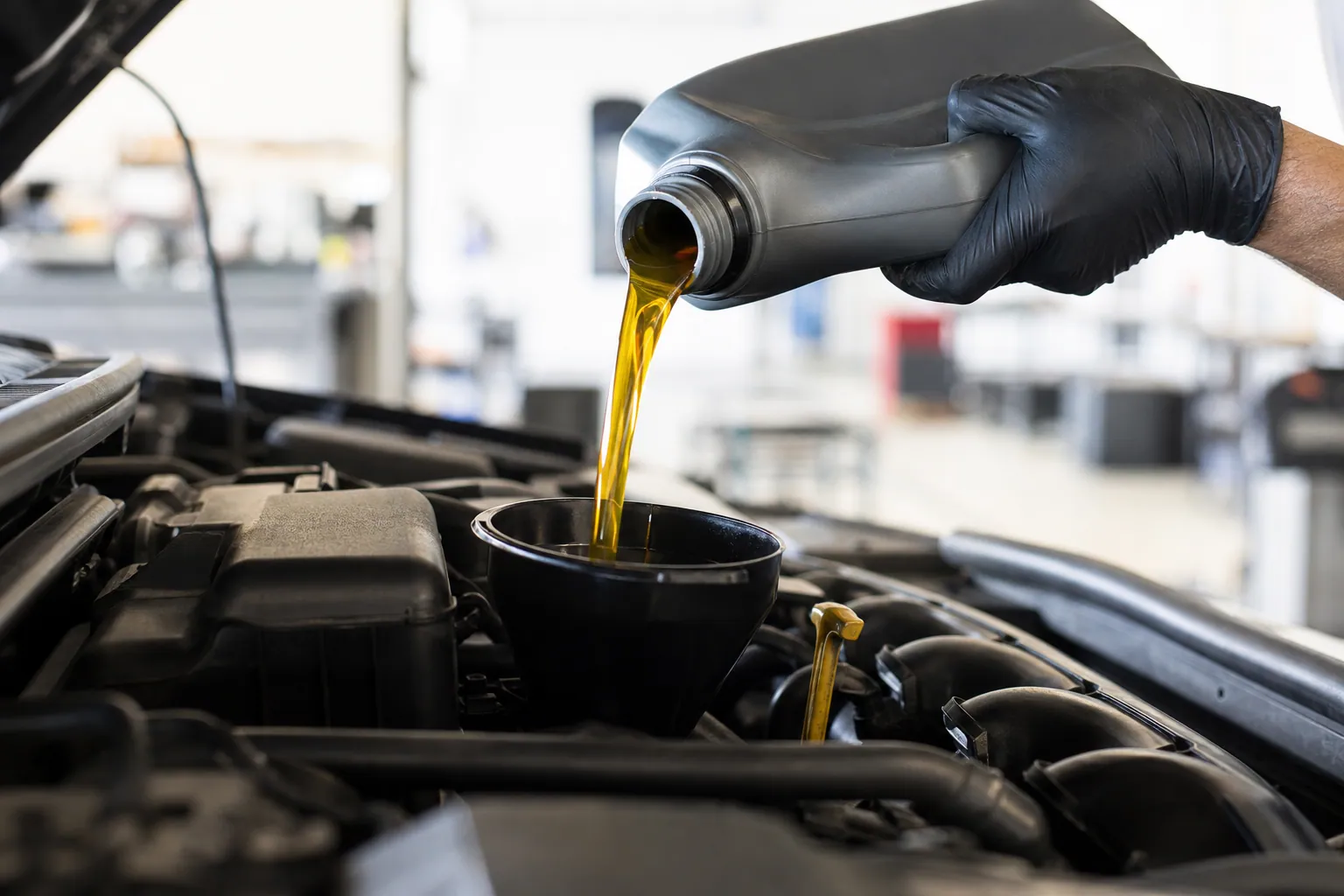
Stand in the oil aisle long enough and you'll notice the same 5W-30 sold in two bottles — one around $6 a quart, the other closer to $12. Marketing wants you to believe more expensive always means better. The honest answer is more useful: each oil has a job, and the right one depends on your engine, your climate, and how you drive.
Below is a plain comparison of synthetic and conventional oil on the three things that matter — cost, change intervals, and protection — with current 2026 prices for each service. By the end, you'll know exactly which one your car needs. Spoiler: for plenty of drivers, the cheaper bottle is still the right call.
Conventional oil is refined straight from crude, so its molecules come in all shapes and sizes. It lubricates fine when fresh, but it breaks down faster under heat, thickens more in freezing weather, and leaves more deposits behind over time.
Full synthetic is chemically engineered from the ground up. Its uniform molecules and stronger additive packages resist heat breakdown, flow almost instantly at cold start, and hold their protective qualities two to three times longer.
Synthetic blend splits the difference — a conventional base with synthetic mixed in. It's a modest upgrade at a modest price, not a halfway version of full synthetic's benefits.
Here's what you can expect to pay at a typical US independent shop this year, including a filter and up to five quarts:
Dealerships usually run $15–$30 higher across the board. The sticker gap between conventional and synthetic looks dramatic — until you factor in how often you're actually paying it.
Conventional oil needs changing every 3,000–5,000 miles. Full synthetic is rated for 7,500–10,000, and some manufacturers approve 12,000–15,000 miles with the right oil and filter.
Run the numbers: a $50 conventional change every 4,000 miles works out to about 1.25 cents per mile. A $95 synthetic change every 8,000 miles is about 1.2 cents per mile. The "expensive" oil is effectively free — you're just paying less often, with better protection the entire time.
One caveat: follow the interval in your owner's manual, not the windshield sticker. Quick-lube shops still print 3,000 miles on cars rated for 10,000.
Some engines genuinely need synthetic, and skipping it costs real money down the road. Use full synthetic if any of these apply:
If you drive an older, naturally aspirated engine — think pre-2012 commuter cars and trucks — that was designed for conventional oil, it will run happily on it for hundreds of thousands of miles, provided you change it on schedule.
Conventional also makes sense for mild climates, short easy commutes, and engines that burn oil. If your car consumes a quart every 1,000 miles, pouring $12-a-quart synthetic through it is money out the tailpipe. It's worth having a licensed shop like Acme Auto Repair diagnose whether that consumption is valve seals, rings, or just a clogged PCV valve — some fixes are cheap, and knowing changes the math.
The one rule that never bends: don't use an oil below the spec printed in your manual. Meeting the spec matters more than the word "synthetic" on the label.
Your owner's manual outranks everything in this article — check it first. If it calls for synthetic, that's settled, and using anything less risks the warranty and the engine.
Beyond that, the decision is simple. Turbo engine, brutal climate, or long intervals: pay for full synthetic, because the per-mile cost is nearly identical anyway. Older engine, moderate driving, changed on time: conventional at $35–$60 protects it just fine.
Either way, the only oil that ruins engines is the change you skip. A $50 service every few months is still the cheapest insurance in all of car ownership.