


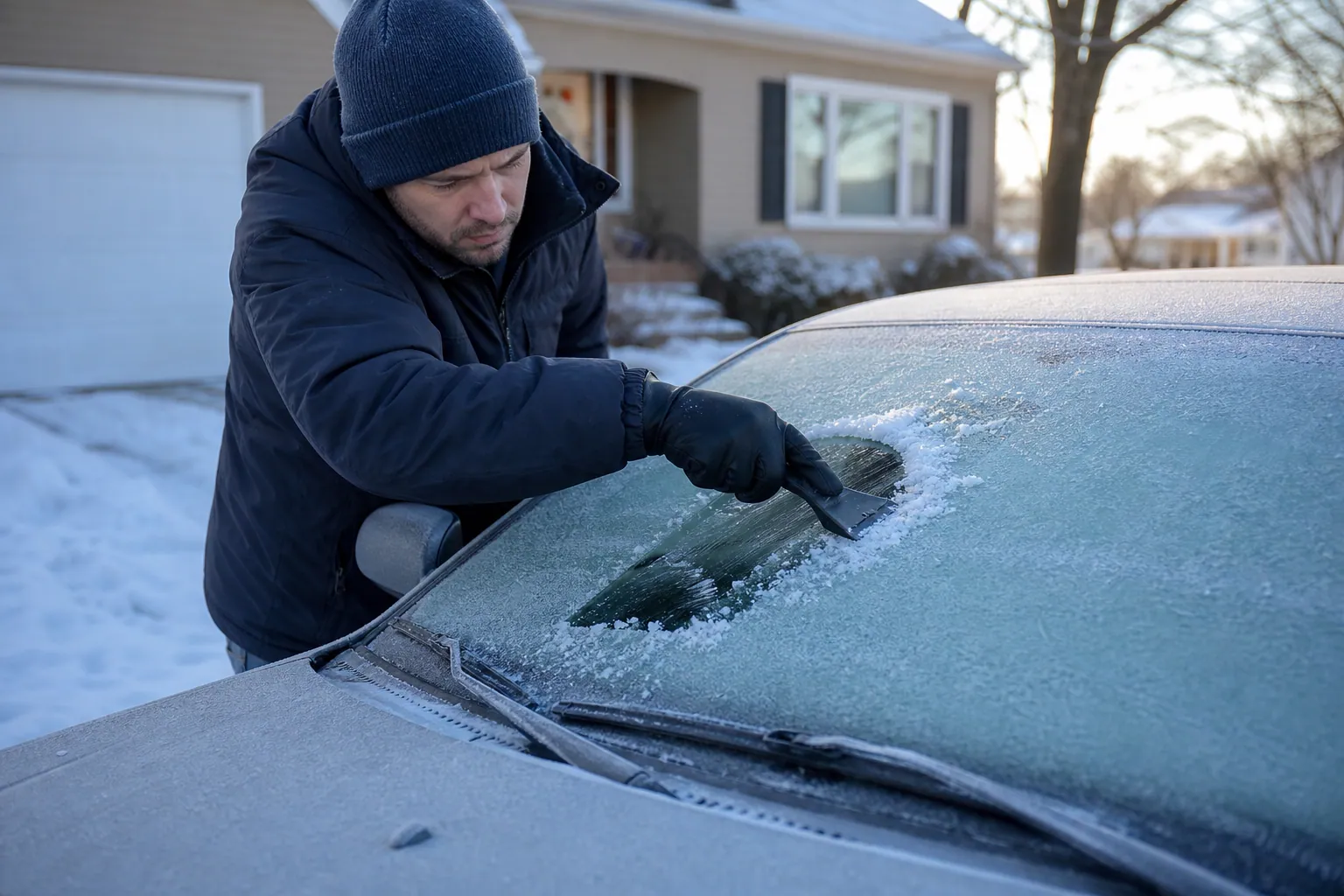
The first hard freeze is when weak parts quit. A battery that cranked fine all fall dies in a grocery store parking lot, summer washer fluid freezes solid in the reservoir, and tires that gripped fine on dry pavement suddenly don't. None of this is bad luck — it's deferred maintenance meeting cold physics.
The good news: most winter prep is cheap and takes one afternoon. Here are ten checks, roughly in order of how likely each one is to strand you, with a clear line between what you can handle in the driveway and what's worth putting on a lift.
Cold is brutal on batteries. At 32°F a battery delivers roughly 35% less cranking power, and at 0°F closer to 60% less — right when thickened oil makes the engine harder to turn over. Check 1 is a load test: most parts stores like AutoZone and O'Reilly will test your battery and charging system for free in about ten minutes.
If the battery is more than four years old or tests marginal, replace it before it decides for you. Most conventional batteries run $150–$250 installed in 2026; AGM batteries in newer cars with stop-start run $250–$400. Check 2 is the terminals: look for white or blue-green crust, clean it off with a wire brush and a baking-soda-and-water paste, and make sure the clamps are snug.
Check 3 is tread depth. The penny test (Lincoln's head upside down — if you can see the top of his head, you're at 2/32") only tells you the legal minimum. For winter, use the quarter test instead: if the top of Washington's head is visible, you're under 4/32", and snow traction drops off fast below that.
Check 4 is pressure. Tires lose about 1 psi for every 10°F drop, so a set adjusted on a 70°F September afternoon is down 4–5 psi by the first 20°F morning. Check them cold, once a month, against the sticker in the driver's door jamb — not the max number on the sidewall. A decent gauge is $10–$15.
One upgrade worth pricing out: if you see regular snow or sustained temps below 40°F, a dedicated winter tire set ($600–$1,200 installed, depending on size) outperforms all-seasons by a wide margin in braking and cornering.
Check 5 is coolant strength. A proper 50/50 antifreeze-water mix protects to about -34°F, and a test strip or floating-ball tester ($5–$10 at any parts store) tells you where you stand in thirty seconds — engine cold, always. Top off with premixed coolant that matches what's already in the car; don't mix types.
Check 6 is washer fluid: swap in winter fluid rated to -20°F or better, about $5 a gallon. Summer fluid freezes, which is useless at best and a cracked reservoir at worst. Check 7 is oil — modern 0W and 5W synthetics flow fine in the cold, so this one is simply about not heading into winter overdue for a change.
Check 8 is wiper blades. If they streak, chatter, or show cracked rubber, replace them — a good beam-style pair runs $25–$50 and takes ten minutes with the diagram on the package. Beam blades handle ice better than old frame-style blades because there's no exposed skeleton to freeze up.
Check 9 is lights and defrosters. Walk around the car with everything on — headlights, brake lights, turn signals — and test the rear defroster grid now, not on the first icy morning. Bulbs are a few dollars, and on most cars they're still a DIY swap.
The whole kit costs $80–$120 if you're starting from zero, and it matters most on rural routes and long commutes. Keep it in a duffel so it doesn't rattle around the trunk:
A few winter items genuinely need a lift, pressure tools, or diagnostics. That's a coolant flush if you're past the interval (typically 5 years or 100,000 miles on modern long-life coolant; $150–$250 in 2026), a brake inspection — cold weather amplifies the cost of worn pads and moisture-contaminated brake fluid — and belts and hoses, since aging rubber turns brittle in the cold and cracks show up under flex, not while parked.
The same goes for chasing a battery that keeps dying: sorting out whether it's the alternator or a parasitic drain is diagnostic work, and it's the kind of job a licensed shop like Acme Auto Repair should handle. Many shops bundle all of it into a winter inspection for $50–$100, often waived with other service — a cheap backstop for everything on this list you'd rather not crawl under the car to verify.